Make
Hold a tile in your hands
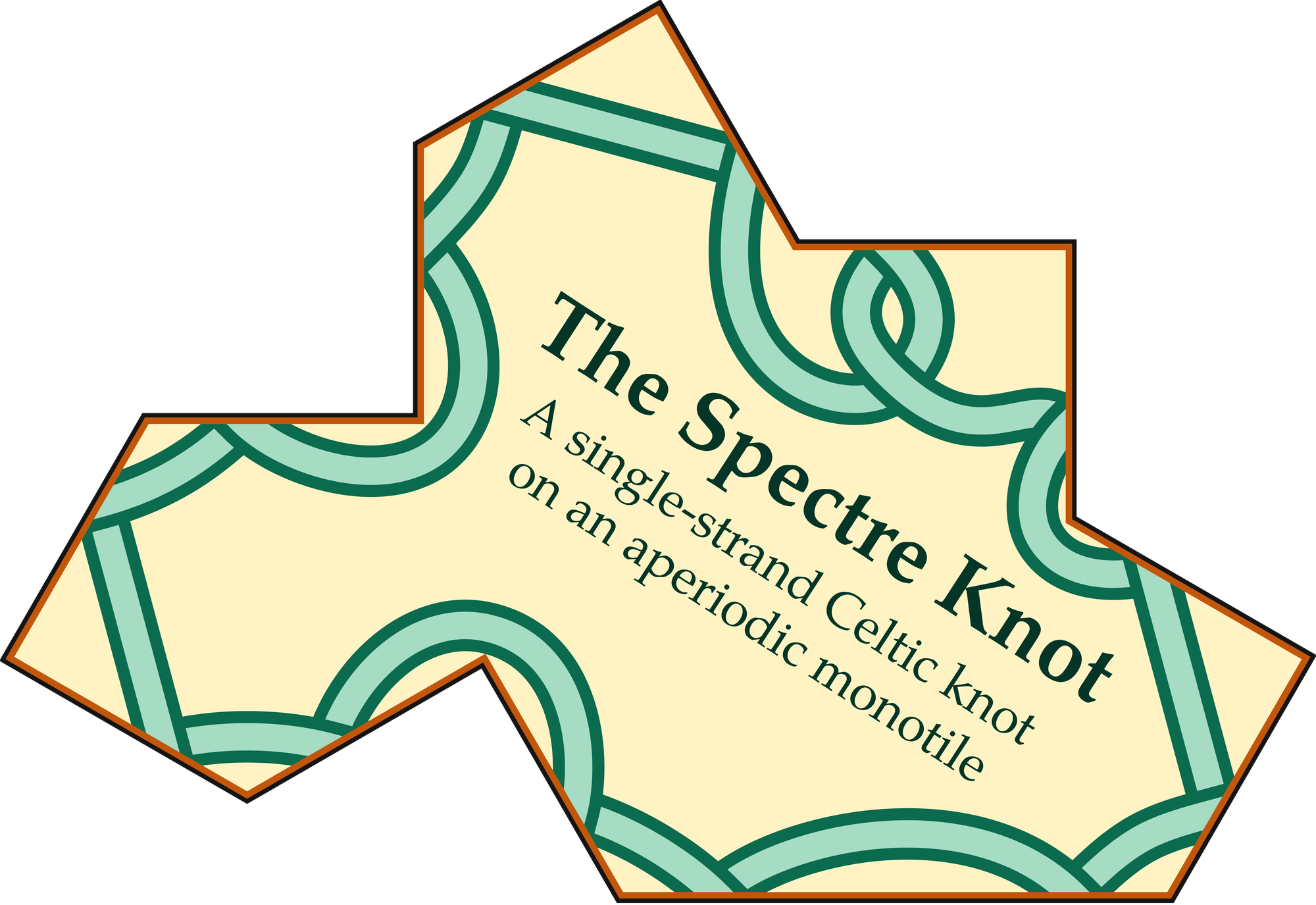
Print the tile, cut it out and fold it. Make several and lay them edge to edge: the ribbons meet where the edges touch and cross there.
The fold-up tile
One sheet of A4 holds the tile and its back, joined along one straight edge. The front carries the knot; the back says what the tile is, who found the spectre, and what the knot does.
- Print the page at actual size (one tile edge is 41 mm).
- Cut round the outer black line, as one piece.
- Fold along the dashed line, printed sides out.
- Glue the halves back to back.
Lay a patch
Spectres fit together without flipping, in patterns that never repeat. Put a few edge to edge and follow a ribbon across the joins. With nine tiles in the right arrangement, as here, you can already see pieces joining into longer strands.
The arrangement is the 9-tile supertile from the spectre paper. On the See page you can watch the same block join up.
Downloads
Next: how is it proved?
Prove →The proof, from a few easy steps down to the full argument.